Targeted Supplementation for Immune Health: What the Science Actually Says
Walk into any pharmacy, health food store, or scroll through any wellness website and you will find hundreds of products promising to “boost your immune system.” The immune supplement market in North America is worth billions of dollars and growing rapidly — yet most people taking these products have no idea whether they are actually working, taking the right dose, or even addressing the right problem.
This page cuts through the noise. Here is what the current science actually says about supplementing for immune health — including what works, what does not, what doses matter, and how to choose products you can actually trust.

The Most Important Truth About Immune Supplements
Before discussing any specific supplement, there is one principle that changes everything: you cannot boost a healthy, well-nourished immune system with supplements. Harvard Medical School is direct on this point — the immune system is not a single entity you can simply accelerate.
In fact, an overstimulated immune system is dangerous. Autoimmune diseases — where the immune system attacks the body’s own tissues — are literally the result of immune overactivation. The goal is never to push immunity higher. The goal is to identify and correct the specific deficiencies and imbalances that are suppressing your immune function, and then get out of the way.
This reframing is critical because it changes your entire approach to supplementation. Instead of grabbing the product with the most immune claims on the label, you ask: What is actually limiting my immune function right now? That question leads to targeted, effective supplementation rather than expensive urine.
Who Actually Benefits From Immune Supplements
Research published in JAMA Network Open in February 2025 found that approximately one in nine Americans uses dietary supplements specifically for immune support. Yet experts from infectious disease, nutrition science, and supplement research consistently note that the people who benefit most are those with specific nutritional deficiencies — not people who are already well-nourished.
The groups most likely to have immune-relevant deficiencies include:
-
People over 50 (absorption of key nutrients declines with age)
-
People with limited sun exposure (Vitamin D deficiency is near-universal in northern latitudes)
-
People on restricted diets (vegan, low-fat, or calorie-restricted)
-
People under chronic stress (stress depletes magnesium, zinc, and B vitamins rapidly)
-
People recovering from illness or surgery
-
People taking certain medications (antacids, metformin, and others deplete specific nutrients)
If you fall into one or more of these categories, targeted supplementation is not just reasonable — it is evidence-based practice.
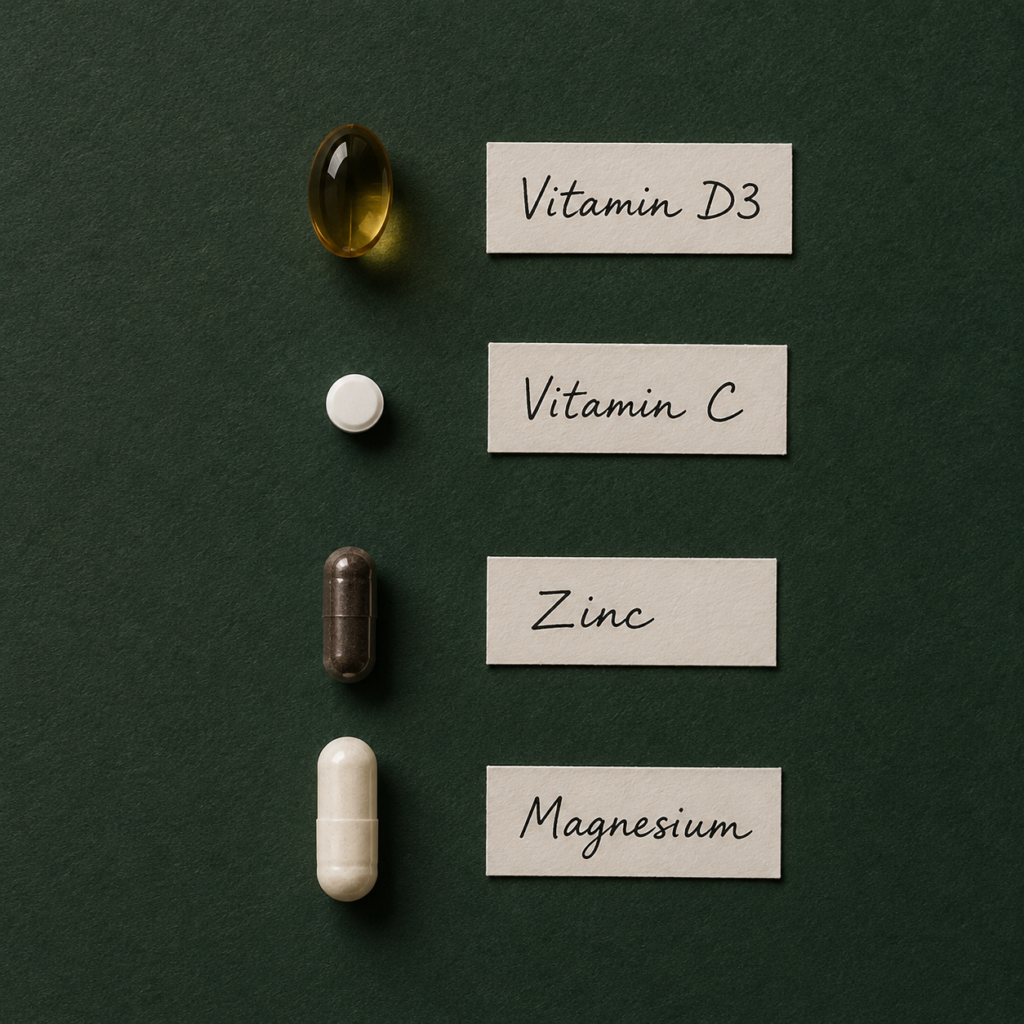
The Core Four: Most Researched Immune Supplements
1. Vitamin D3 — The Immune Hormone
Vitamin D is perhaps the most important immune-related nutrient, and deficiency is extraordinarily common. It functions less like a traditional vitamin and more like a hormone — regulating over 200 genes, many of which directly control immune cell activation, differentiation, and inflammatory response.
Research published in PMC in April 2024 confirms that Vitamin D plays a dual role in immunity: it activates innate immune defenses against pathogens while simultaneously helping regulate adaptive immunity to prevent overreaction and autoimmunity. Deficiency is consistently associated with:
-
Increased frequency and severity of respiratory infections
-
Elevated inflammatory markers
-
Higher risk of autoimmune conditions
-
Slower recovery from illness
What the research says about dosing:
-
The NIH’s Office of Dietary Supplements recommends 600-800 IU daily as a minimum — but this is widely considered inadequate by researchers.
-
Most functional medicine practitioners and researchers recommend 2,000-5,000 IU daily for adults, ideally based on blood testing
-
Target blood levels: 40-60 ng/mL for immune optimization
-
Always take D3 (not D2), ideally with a meal containing fat for absorption
-
Consider combining with Vitamin K2 (MK-7 form) to ensure calcium is directed to bones rather than arteries
Food sources: Fatty fish (salmon, mackerel, sardines), egg yolks, fortified dairy — but food sources alone are rarely sufficient to maintain optimal levels.
2. Zinc — The Immune Gatekeeper
Cleveland Clinic researchers call zinc the “gatekeeper” of the immune system — and for good reason. Zinc is required for the development, activation, and proliferation of virtually every type of immune cell including T-cells, B-cells, natural killer cells, and macrophages. Even mild zinc deficiency measurably impairs immune response.
Zinc also has direct antiviral properties. It inhibits viral replication by blocking a specific enzyme that many viruses use to copy their genetic material — which is why zinc lozenges taken at the first sign of a cold have shown consistent evidence of reducing duration.
What the research says about dosing:
-
The NIH recommends 8mg daily for women and 11mg for men as a baseline.
-
Therapeutic immune support: 15-30mg daily
-
For acute illness: 75mg+ daily (lozenges or acetate form) — but only for short periods; long-term high-dose zinc depletes copper
-
Best absorbed forms: zinc picolinate, zinc glycinate, zinc acetate
-
Avoid zinc oxide — poorly absorbed
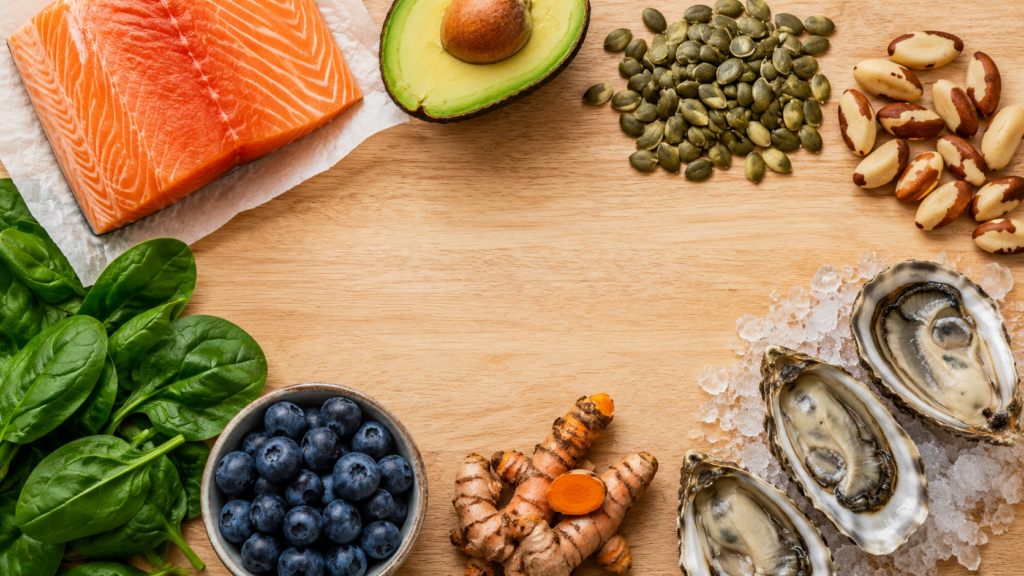
Food sources: Oysters (highest known food source), red meat, poultry, beans, nuts, whole grains, pumpkin seeds.
Important interaction: Zinc competes with copper for absorption. If supplementing zinc long-term at doses above 15mg, add 1-2mg of copper to maintain balance.
3. Magnesium — The Overlooked Immune Regulator
Magnesium is involved in over 300 enzymatic reactions in the human body — including many that directly regulate immune signaling and inflammatory response. Yet an estimated 50% of Americans consume less than the recommended daily amount.
Magnesium deficiency is associated with elevated C-reactive protein (CRP) — a primary marker of systemic inflammation — and impaired function of both innate and adaptive immune cells. Chronic stress dramatically accelerates magnesium depletion, creating a vicious cycle where stress suppresses immunity partly through magnesium loss.
What the research says about dosing:
-
NIH recommends 310-420mg daily depending on age and sex.
-
Many researchers suggest 350-500mg for adults under chronic stress
-
Best absorbed forms: magnesium glycinate (most bioavailable, gentlest on digestion), magnesium malate (energy support), magnesium threonate (brain penetration)
-
Avoid magnesium oxide — poorly absorbed and causes digestive distress
Food sources: Dark leafy greens, pumpkin seeds, black beans, avocado, dark chocolate, whole grains.
4. Vitamin C — Antioxidant Defense and Immune Support
Vitamin C is perhaps the most popular immune supplement in the world — and also one of the most misunderstood. The evidence for Vitamin C is more nuanced than most marketing suggests.
A 2013 Cochrane review of over 11,000 participants found that regular Vitamin C supplementation did not significantly reduce cold incidence in the general population — but it did reduce duration by 8-14% when taken consistently. More importantly, Vitamin C plays critical roles in:
-
Supporting neutrophil function — the frontline immune cells that engulf and destroy pathogens
-
Acting as a potent antioxidant that protects immune cells from oxidative damage during active infections
-
Regenerating other antioxidants including Vitamin E
-
Supporting skin barrier integrity as a first line of physical defense
What the research says about dosing:
-
NIH recommends 75-90mg daily as a baseline.
-
For immune support: 500-1,000mg daily in divided doses
-
Upper limit: 2,000mg daily — doses above this provide no additional benefit and cause digestive distress
-
Liposomal Vitamin C offers significantly higher absorption than standard ascorbic acid
-
Take with meals to reduce stomach upset

Secondary Supplements With Solid Evidence
Probiotics
The gut-immune connection means that probiotic supplementation has a legitimate place in an immune support stack. Look for multi-strain formulas with at least 10 billion CFU containing Lactobacillus acidophilus, Lactobacillus rhamnosus, and Bifidobacterium longum — strains with the strongest clinical evidence for immune modulation.
Quercetin
Quercetin is a plant flavonoid with two particularly relevant immune properties: it has direct antiviral activity and acts as a zinc ionophore — helping zinc enter cells more effectively, amplifying zinc’s antiviral effects. Found naturally in onions, capers, apples, and berries. Supplement dose: 500-1,000mg daily with meals.
Elderberry (Sambucus nigra)
Multiple clinical trials show that standardized elderberry extract reduces the duration and severity of influenza symptoms. A 2016 randomized controlled trial found that air travelers taking elderberry experienced significantly shorter and less severe colds compared to placebo. Dose: 300-600mg extract standardized to 3.2% anthocyanins.
Omega-3 Fatty Acids (EPA/DHA)
Omega-3s from fish oil reduce chronic systemic inflammation and support the resolution phase of acute immune responses — helping the immune system stand down after a threat has been neutralized. This resolution function is as important as activation. Target 1,000-3,000mg combined EPA+DHA daily from a quality, third-party tested fish oil.
Selenium
Selenium is essential for the production of glutathione peroxidase — one of the body’s most important antioxidant enzymes — and supports both innate and adaptive immune function. Brazil nuts (1-2 per day) provide the entire daily requirement. Supplement dose if needed: 100-200mcg daily.
What Does Not Have Strong Evidence
Echinacea
Evidence is mixed and inconsistent. Some studies show modest benefit when taken at the first sign of illness. Regular preventive use has not demonstrated significant benefit in well-designed trials.
Colloidal silver
No credible clinical evidence supports immune benefits. Can accumulate in the body and cause permanent skin discoloration (argyria) with long-term use. The FDA has explicitly stated there is no evidence it is safe or effective.
Mega-dose Vitamin C (above 2,000mg)
Provides no benefit beyond standard doses and increases risk of kidney stones and digestive distress.
Generic “Immune Boost” Blends
Most multi-ingredient immune blends contain 10-15 ingredients at doses too low to be therapeutically effective for any single ingredient. They are designed to impress on a label, not to work in your body.
How to Choose Quality Supplements
This is where most consumers go wrong. The supplement industry in the United States is regulated as a food, not a drug — meaning supplements do not require FDA approval before reaching shelves. The quality difference between brands is enormous.
Always look for third-party certification seals:
-
NSF International — The NSF tests against NSF/ANSI 173, the only American National Standard for dietary supplement ingredients. NSF does not evaluate data submitted by manufacturers — it independently tests the actual product.
-
USP (United States Pharmacopeia) — Verifies that products contain the labeled ingredients at stated potency and are free from harmful contaminants.
-
Informed Sport — Specifically relevant for athletes; tests for banned substances in addition to quality and purity.
Harvard Medical School advises consumers to use the Operation Supplement Safety Scorecard (available through the Department of Defense) to quickly evaluate any supplement’s safety profile before purchasing.
Additional quality markers to look for:
-
Fewer than six active ingredients
-
Transparent labeling (no “proprietary blends” hiding individual doses)
-
Clear expiration date and lot number
-
GMP (Good Manufacturing Practice) certification on the label
-
No outlandish health claims
The Smart Supplementation Framework
Step 1: Test before you supplement
Get blood levels of Vitamin D (25-OH), zinc, magnesium RBC, and ferritin checked before spending money on supplements. Know your specific deficiencies.
Step 2: Fix deficiencies first
Address confirmed nutritional gaps with targeted supplementation before adding secondary supports.
Step 3: Choose quality over quantity
Three well-chosen, third-party tested supplements will outperform a cabinet full of cheap, unverified products every time.
Step 4: Prioritize consistency over intensity
Daily low-dose supplementation at therapeutic levels far outperforms occasional high-dose loading. Nutrients work through consistent presence, not spikes.
Step 5: Food first — always
Supplements fill gaps. They do not replace a nutrient-dense, whole-food diet. A diet rich in vegetables, fruits, quality proteins, healthy fats, and fermented foods provides the foundation that no supplement can fully replicate.
Step 6: Reassess every 6 months
Supplement needs change with seasons, stress levels, age, and health status. Retest blood levels periodically and adjust accordingly.